Verify the payee before money moves, at network scale.
Real-time payments settle in seconds and can’t be pulled back. PayVerify confirms the person, business and bank account behind a payee in real time, so scam and mule payments stop on your rails while legitimate payments keep moving.
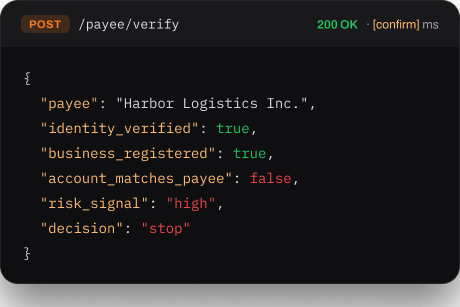
Illustrative response. Field names to confirm with engineering.
Faster rails mean less time to catch a scam.
Instant payments are final.
Once a real-time payment settles, there is usually no getting it back. The only moment to stop a scam is before it clears.
Mule accounts move between institutions.
Scam proceeds rarely stay at one bank. Each participant on your network sees only its own piece of the pattern.
Expectations are moving to the network.
New rules, including NACHA’s 2026 requirement to identify mule accounts, raise the bar for everyone who moves money, and participants look to their network for help meeting it.
PayVerify: payee verification built into the payment.

Bank account verification
Confirms the receiving account exists, is valid and belongs to the payee named on the payment.

Business verification
Checks the receiving business’s registration, ownership and reviews before funds go out.

Identity verification (IDeveryone)
Confirms the person behind a payee is who they claim to be.

Pre-Verification Intelligence
Runs in the background on relevant payments and returns a risk signal continuously. It only asks for action when that signal, combined with the risk data you already hold, crosses a meaningful threshold.
COVERAGE
Push and real-time payments
ACH and wire
Cryptocurrency
Checks
One call at initiation, one answer back.
A payment is initiated.
Your platform sends the payee details to PayVerify through the API.
PayVerify checks the payee.
Identity, business and bank account are verified in real time.
A risk signal comes back.
Most payments pass with no visible step. High-risk payments return a clear decision: proceed, override or stop.
Participants act on it.
The sending institution, and the customer where relevant, gets the answer before funds move.
Built for everyone who moves money at scale.

Payment networks & schemes
Confirms the receiving account exists, is valid and belongs to the payee named on the payment.

Processors
Add verification to the payment flows you already run for banks and credit unions.

Acquirers & merchant services
Confirm the businesses you onboard and pay out to are who they say they are.

Real-time payment operators
Stop irrevocable scam payments in the seconds before settlement.
Fast enough for real-time rails.
PayVerify adds a payee answer to the risk signals you already have. It works alongside your monitoring and does not replace it.
[confirm] ms
Typical latency per verification
[confirm] %
Uptime commitment, detailed on the Reliability page
[confirm] ms
Throughput or largest volume served
Alongside
Works with the monitoring you have
The cost of getting it wrong.
FTC Consumer Sentinel 2024
FTC 2024
FBI IC3 2024

CUSTOMER STORY
One processor or network result. [confirm which partner we can feature]

Founding cybersecurity partner of Scam.org (GASA + OpenAI)

SOC 2-aligned, monitored via Vanta [confirm “aligned” vs “compliant”]

Advisors from the U.S. Secret Service and financial-industry fraud leadership
Questions payment teams ask us
Does PayVerify replace our fraud scoring?
No. It adds a definitive answer about the payee to the signals you already use.
Will verification slow payments down?
No. Keep the monitoring you have. PayVerify handles what happens after a payment is flagged, with a definitive answer about the payee.
What data do you need, and where is it stored?
No. Keep the monitoring you have. PayVerify handles what happens after a payment is flagged, with a definitive answer about the payee.
How do we integrate?
No. Keep the monitoring you have. PayVerify handles what happens after a payment is flagged, with a definitive answer about the payee.